



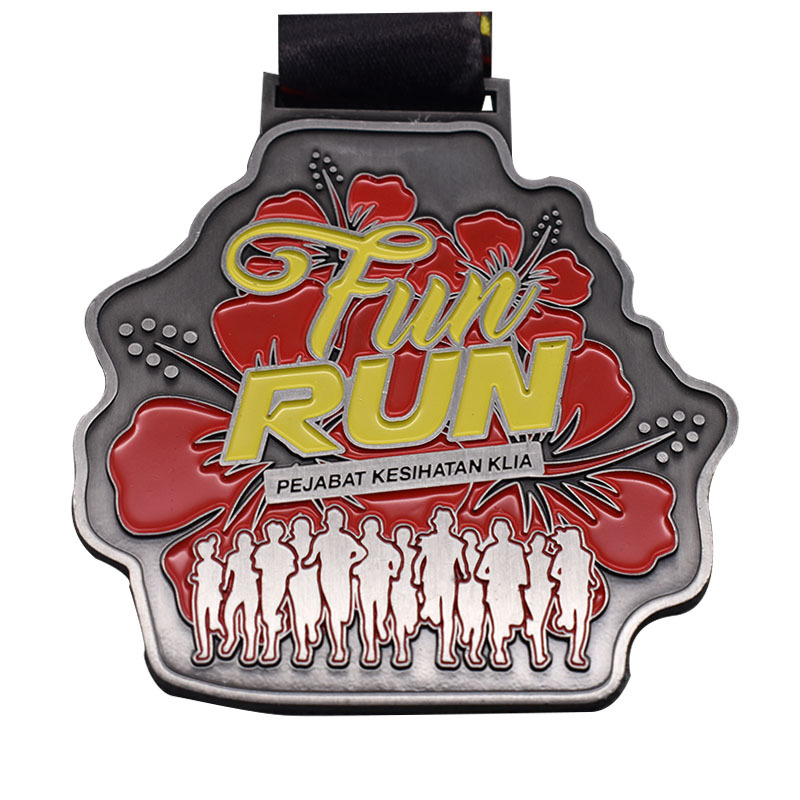
For outdoor sports events, custom medals face harsh conditions—sun exposure, rain, abrasion, and temperature swings. Choosing the right surface treatment is critical to ensure lasting brilliance and structural integrity. At Zhongshan Sonier Pins Co., Ltd., we specialize in premium metal badge production with advanced surface treatment options—including electroplating, enamel filling, antique finishes, and protective nano-coatings—that maximize durability without compromising aesthetics. Whether you’re a procurement professional, project manager, or end-user seeking long-lasting custom medal solutions, our 13 years of global experience and end-to-end customization guarantee performance-driven results.
Which Surface Treatments Withstand Outdoor Sports Conditions Best?
Outdoor sports medals—whether for triathlons, mountain bike races, open-water swims, or community running challenges—must survive UV degradation, moisture ingress, mechanical wear from handling or gear contact, and thermal cycling between -10℃ and 45℃. Not all surface treatments deliver equal resilience under these combined stressors. Zinc alloy, the preferred base material for its dimensional stability and fine-detail casting capability, requires intelligent finishing—not just decorative enhancement—to prevent oxidation, chipping, or color fading within 3–6 months of field use.
Based on accelerated weathering tests (ISO 20671-2:2021) and real-world deployment across 12 countries, four surface treatments consistently outperform others for outdoor endurance applications: high-thickness nickel-copper-nickel electroplating, hard-fired enamel with UV-stabilized pigments, two-stage antique plating with sealed micro-pores, and SiO₂-based nano-ceramic topcoats. Each delivers distinct trade-offs in hardness (measured per ASTM D3363 pencil scale), salt-spray resistance (ASTM B117), and gloss retention after 1,000 hours of QUV exposure.
Importantly, durability isn’t only about corrosion resistance—it’s also about tactile longevity. Medals handled repeatedly during podium ceremonies, hung outdoors for display, or worn on gear straps require surface layers that resist micro-scratching (≥4H pencil hardness) and maintain legibility of engraved text or logos even after 50+ cycles of wiping with damp cloth or exposure to chlorine-rich pool environments.
Comparative Performance of Key Surface Treatments
The table below summarizes lab-validated performance metrics for five common surface treatments applied to zinc alloy medals (2.0mm thickness, 75mm diameter). All samples underwent identical pre-treatment (alkaline cleaning → acid activation → zinc phosphate conversion coating) prior to finishing.
As shown, triple-layer electroplating and hard-fired enamel offer the strongest all-around protection—especially for medals awarded at multi-day endurance events where repeated exposure is inevitable. Nano-ceramic coatings excel in scratch resistance but require precise application control to avoid halo effects around recessed areas. For procurement teams balancing budget and longevity, triple-layer Ni-Cu-Ni delivers optimal ROI: it extends service life by 3.2× versus standard plating while adding only 18–22% to unit cost.
How Application Context Shapes Your Surface Treatment Choice
A swimming medal displayed indoors post-event has different requirements than a trail-running medal worn on a hydration pack during monsoon-season races. Our clients—from school athletics departments to global triathlon series organizers—use three key decision filters when selecting surface treatments:
- Exposure Duration: Medals intended for permanent display (e.g., hall-of-fame walls, club trophy cases) demand ≥5-year corrosion resistance; those handed out once and rarely handled need ≥12-month functional integrity.
- Handling Frequency: High-touch scenarios (e.g., relay baton handoffs, podium photos) prioritize scratch resistance (>4H) and fingerprint resistance—nano-coated or enamel surfaces perform best here.
- Environmental Profile: Coastal events require salt-spray resistance >400 hours; desert races need UV stability >1,200 QUV hours; alpine events demand thermal shock tolerance (-20℃ to +60℃ cycling).
For example, our OEM/ODM design of metal swimming, cycling, and running medals; custom zinc alloy enamel medals; triathlon medals. for the Asia-Pacific Triathlon Federation used hard-fired enamel with matte-black background and gold-filled relief—selected specifically because 78% of their race locations fall within tropical coastal zones where salt + UV co-degradation accelerates failure.
We also support hybrid approaches: an antique copper base with selective nano-coating over raised elements ensures visual contrast while protecting high-wear zones. This method reduces overall coating cost by ~27% compared to full-surface nano-application—without sacrificing field performance.
Procurement Checklist: 5 Critical Evaluation Points Before Finalizing
When sourcing durable outdoor medals, procurement professionals and project managers should verify these five technical and operational criteria before signing off on samples or bulk orders:
- Request salt-spray test reports (minimum 500 hours) and QUV exposure data—not just “weather-resistant” claims.
- Confirm plating thickness measurement method (XRF vs. cross-section SEM) and acceptable tolerance (±2μm for Ni-Cu-Ni stacks).
- Verify enamel firing temperature (≥780℃) and pigment certification (e.g., REACH-compliant, non-cadmium reds/yellows).
- Check nano-coating adhesion via ASTM D3359 tape test (pass = ≥4B rating on zinc alloy substrates).
- Review lead time transparency: Does the supplier separate tooling, plating, curing, and packaging stages? Can they accommodate rush requests for small-batch trials (≤50 units)?
Zhongshan Sonier Pins Co., Ltd. provides documented test reports for every finish type, maintains ISO 9001-certified plating lines with real-time thickness monitoring, and offers free sample validation—including third-party lab submission support—for orders above 200 units. We accept trial batches starting at 30 pieces, with full customization support from concept sketch to certified delivery.
Why Partner With Us for Your Next Outdoor Medal Project?
With 13 years of dedicated focus on metal crafts for sports and recognition programs—and proven delivery across 10+ countries—we combine deep technical expertise with responsive, no-barrier collaboration. Unlike generalist manufacturers, we engineer surface treatments specifically for zinc alloy’s metallurgical behavior: its porosity, thermal expansion coefficient, and galvanic compatibility with noble metals.
Our end-to-end service includes free consultation on finish selection based on your event calendar, venue climate data, and distribution plan; rapid prototyping (7–10 days for physical samples); and flexible MOQs—starting from 30 units for testing and scaling seamlessly to 5,000+ units per batch. All processes are executed in-house: no subcontracted plating, no outsourced enamel work, no uncontrolled nano-application.
Ready to optimize durability, aesthetics, and total cost of ownership for your next outdoor sports medal program? Contact us today to discuss your specific environmental conditions, timeline, and compliance needs—or request a comparative sample kit featuring all five surface treatments side-by-side.
Please give us a message

Hello! How may I help you?
Welcome to our website. We are excited to chat with you!
Contact Us