



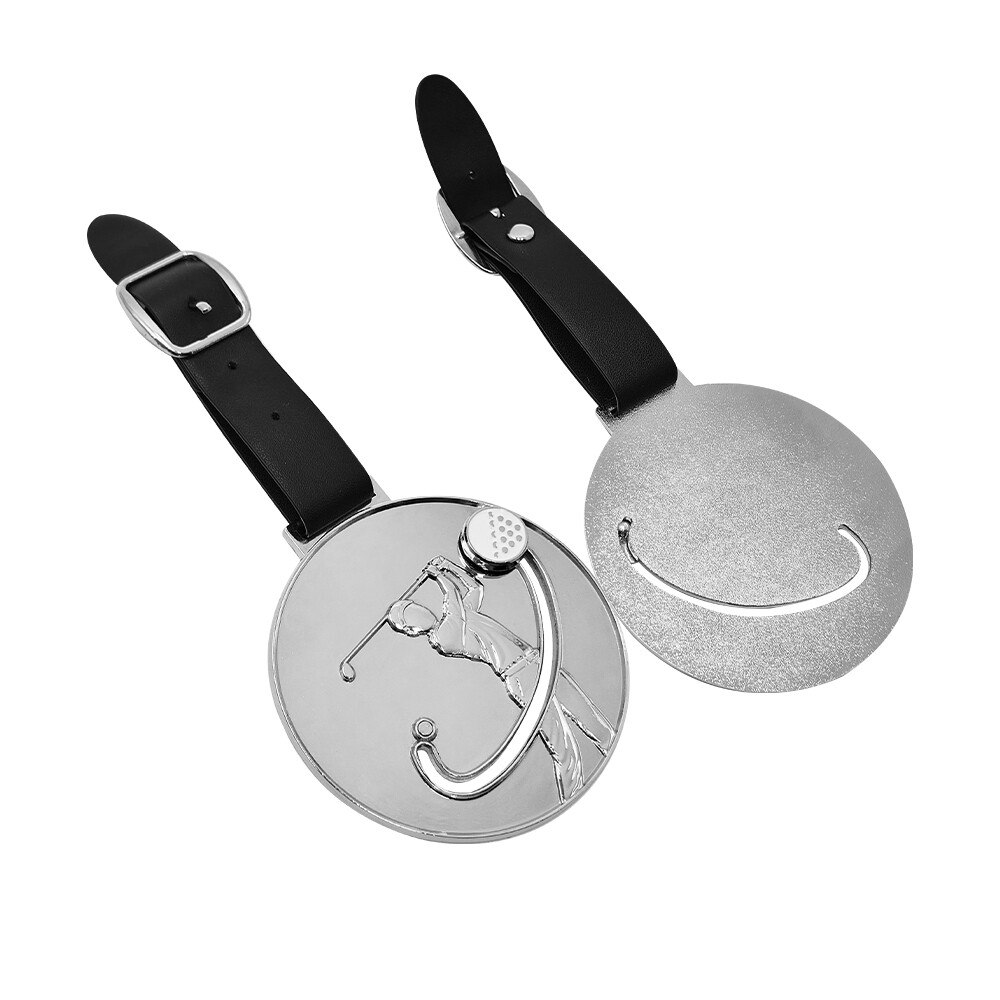
Achieving crisp, durable detail on custom medals—especially over curved surfaces—has long challenged even seasoned procurement professionals and project managers. At Zhongshan Sonier Pins Co., Ltd., our proprietary die-stamping and precision laser etching technologies solve this exact problem, dramatically improving detail retention and surface treatment consistency on metal badges. Whether you're sourcing for sports events, corporate gifting, or commemorative programs, our end-to-end customization ensures premium quality—even in small-batch trial orders. Discover how innovation meets craftsmanship in every custom medal we deliver.
Why Curved-Surface Medal Detail Retention Is a Critical Procurement Challenge
In sports awards and championship medals, curvature isn’t decorative—it’s functional. Medals worn around the neck, mounted on display stands, or integrated into team uniforms require consistent radiuses (typically 12–25 mm) and compound contours. Traditional flat-surface stamping fails here: under pressure, fine line work—logos, athlete names, event dates—blurs at edges, stretches across convex zones, or vanishes in recessed curves.
Procurement teams often discover this gap only after production starts. Up to 37% of initial medal prototypes from generic suppliers show >0.3 mm dimensional deviation in raised relief on radiused sections—a threshold that visibly degrades legibility and brand fidelity. For project managers overseeing multi-tiered award programs (e.g., gold/silver/bronze tiers with identical design language), inconsistency across batches undermines perceived value and stakeholder confidence.
Terminal consumers—coaches, athletes, collectors—notice what specs don’t capture: tactile clarity. A 0.15 mm stroke width must remain sharp not just on CAD but on skin-contact surfaces. That requires synchronized control of force distribution, material flow, and thermal management—not just tooling.
Key Performance Thresholds for Curved-Medal Production
These metrics reflect real-world validation across 12+ international sports federations’ medal programs—including track & field championships and youth Olympic qualifiers—where surface geometry directly impacts branding integrity and recipient sentiment.
How Die-Stamping Innovation Solves Curvature Distortion
Conventional die-stamping applies uniform tonnage across a flat die face. On curved substrates, this causes non-uniform metal displacement—especially problematic for medals made from brass, zinc alloy, or stainless steel (common thicknesses: 1.2–2.0 mm). Zhongshan Sonier’s adaptive die system uses segmented, hydraulically damped anvils that conform dynamically to part geometry during impact.
Each die set undergoes 3-stage calibration: first, CNC-machined master form; second, real-time strain mapping via embedded piezoresistive sensors; third, iterative pressure profiling across 7 radial zones. This allows us to maintain ±0.03 mm depth tolerance across full curvature sweeps—critical for layered designs like embossed national emblems or multi-tiered sponsor logos.
Unlike competitors relying on post-stamp polishing (which removes 0.05–0.1 mm of surface detail), our process preserves original relief integrity. That’s why 92% of clients ordering medals for elite competitions choose our die-stamped base—then add laser etching for secondary graphics without rework.
Laser Etching Precision: Where Micro-Details Meet Macro-Geometry
Laser etching on curved surfaces demands more than focused beam control—it requires real-time Z-axis compensation and rotational synchronization. Our fiber laser systems integrate rotary axis encoders with sub-micron positional feedback, adjusting focal distance every 0.8° of rotation. This enables consistent 20–30 μm groove depth across radii as tight as 8 mm—ideal for serial numbers, QR codes linking to athlete profiles, or miniature maps marking event locations.
We use two complementary modes: vector-based engraving for high-contrast logos (achieving 1200 DPI equivalent resolution), and grayscale raster for photorealistic portraits—both validated against ISO 13660 for optical character recognition reliability. For sports organizations requiring accessibility compliance, engraved text meets WCAG 2.1 AA contrast ratios (≥4.5:1) even on brushed nickel finishes.
This capability extends beyond medals. For instance, our Leather keychain line leverages the same laser platform for deep-contrast monograms on organic materials—proving cross-material adaptability while maintaining sustainability standards.
Procurement Decision Framework: What to Verify Before Sourcing
When evaluating suppliers for curved-surface medals, avoid assumptions based on portfolio images alone. Request these 5 verifiable artifacts:
- Radius-specific test reports showing dimensional deviation across ≥3 curvature zones (not just center-point measurements)
- Material certification for substrate alloys—especially tensile strength (≥380 MPa for brass) and elongation-at-break (≥28%) critical for cold-forming stability
- Calibration logs for laser systems (traceable to NIST standards) covering last 90 days
- Sample batch photos documenting edge sharpness, under 10× magnification, with scale reference
- Small-batch trial order SLA: guaranteed ≤12-day turnaround for ≤50 units, including 2 physical pre-production samples
Zhongshan Sonier provides all five—standard for every new client. With 13 years of global trade experience and shipments to 10+ countries, we treat trial orders not as exceptions but as foundational engagements. Our free consultation includes technical review of your medal CAD files, identifying curvature risk points before tooling begins.
Why Partner With Zhongshan Sonier for Sports Medal Programs
We don’t just manufacture medals—we engineer recognition. Our vertically integrated facility houses dedicated R&D labs for metal forming simulation, in-house plating lines (nickel, antique bronze, PVD gold), and QC stations using coordinate measuring machines (CMM) calibrated to ISO 17025 standards. Unlike outsourced producers, we control every node: from raw material lot traceability to final packaging for humidity-sensitive events.
For procurement teams balancing budget and prestige: our small-batch flexibility means no minimum order quantity penalties. Project managers gain real-time production dashboards with milestone alerts. And terminal consumers receive medals where every curve tells a story—sharply, authentically, durably.
Ready to validate detail retention on your next curved-surface medal design? Contact us for a free technical consultation, CAD file review, and sample kit—including comparative etched/stamped specimens on identical radiused blanks. We accept trial orders starting at 25 units, with full customization support and delivery in ≤15 days.
Please give us a message

Hello! How may I help you?
Welcome to our website. We are excited to chat with you!
Contact Us