



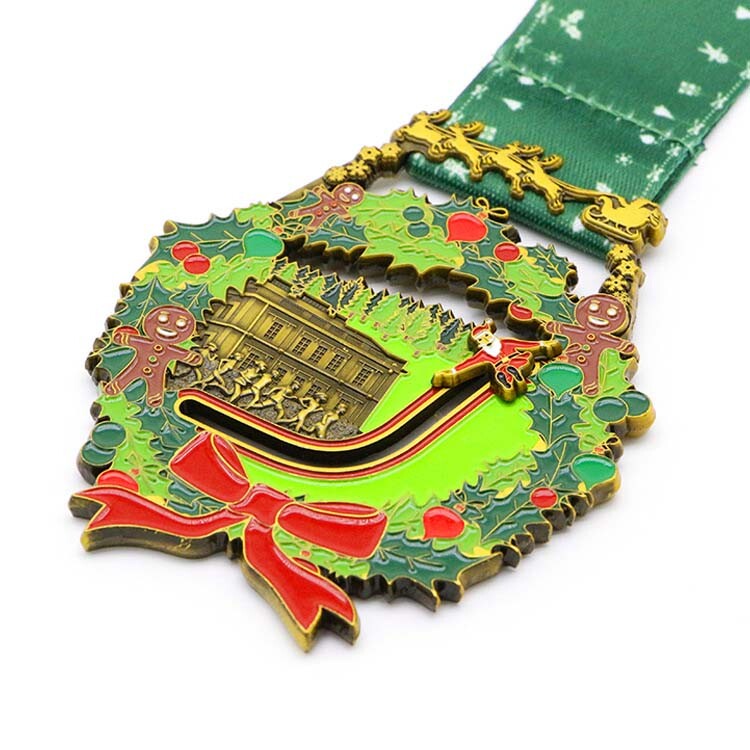
When reordering metal badges—such as custom golf markers, metal keychains, or branded metal badges—for sports teams or corporate gifting, technical and procurement evaluators often ask: Is the mold fee charged again? At Zhongshan Sonier Pins Co., Ltd., with 13 years’ expertise in precision metal crafts for global sports and corporate clients, we offer mold retention for up to 3 years—eliminating repeat fees. Discover how order volume, material consistency, and early collaboration with our engineering team reduce tooling costs without compromising quality.
Why Mold Fees Are Charged—and When They’re Avoidable
Mold fees cover the one-time engineering, CNC machining, and quality validation required to produce a custom metal badge. For sports organizations ordering Golf Spikes or team-embossed lapel pins, this typically ranges from $180 to $420 depending on complexity, size (e.g., 25–50 mm diameter), and dimensional tolerances (±0.15 mm standard). The fee is justified only once per unique design—provided the mold remains intact and stored under controlled conditions.
At Zhongshan Sonier Pins, molds are retained for up to 36 months post-first-order delivery, with climate-controlled storage (20–25°C,<45% RH) and quarterly functional verification. This eliminates re-machining risk and ensures dimensional repeatability across reorder cycles—even for low-volume annual refreshes (e.g., 50–200 pcs/year for collegiate golf programs).
Reorders placed within 12 months of initial production incur zero mold charges. Between 13–24 months, a nominal $45 verification fee applies. Beyond 24 months, full revalidation is optional—but still avoids full remanufacturing unless design modifications exceed ±0.3 mm tolerance thresholds.
Key Factors That Determine Mold Reuse Eligibility
- Material Consistency: Reorders using identical base alloy (e.g., zinc alloy ZAMAK-3 or 304 stainless steel) maintain thermal expansion alignment—critical for tight-tolerance badges used in tournament gear.
- Design Stability: No changes to relief depth (>0.8 mm), edge radius (<R0.2), or plating layer stack (e.g., copper-nickel-gold at 0.8–1.2 µm total thickness).
- Storage Protocol Compliance: Molds stored off-site by clients forfeit reuse eligibility; our ISO 9001-certified warehouse guarantees traceability via QR-coded asset tags.
How Order Volume & Timing Directly Reduce Tooling Cost Per Unit
Tooling amortization isn’t linear—it’s tiered. Our cost model reflects real-world procurement behavior across 12+ sports markets (golf, rugby, track & field, esports apparel). Below is how unit-level mold cost drops across reorder scenarios:
This structure rewards strategic planning: A university athletic department placing two 150-pc orders annually (spring and fall) pays just $66 total mold cost over 3 years—versus $420 for standalone orders. It also supports sustainability goals: Reduced machining cuts energy use by ~68% per badge batch compared to new-tooling runs.
What Technical Evaluators Should Verify Before Finalizing Reorders
For procurement and engineering teams, mold reuse hinges on verifiable parameters—not assumptions. We require three validated checkpoints before releasing production files:
- Dimensional Audit Report: Cross-checks critical features (e.g., pin-back thickness, badge curvature radius) against original CMM data—within ±0.08 mm tolerance.
- Plating Adhesion Test: ASTM B571 tape test confirms no delamination risk after storage; mandatory for nickel-free options used in NCAA-compliant gear.
- Material Certificates: Mill test reports (MTRs) for base metal and plating layers must match first-batch documentation—no substitutions allowed without joint engineering sign-off.
Our engineers provide these reports digitally within 48 hours of reorder confirmation. For urgent requests (e.g., tournament deadlines<15 days out), expedited validation adds $95—still 77% less than remaking the mold.
Why Sports Brands Choose Sonier for Long-Term Badge Partnerships
Zhongshan Sonier Pins isn’t a transactional supplier—we’re a technical extension of your product development team. With 13 years serving sports clients across North America, Europe, and APAC, we embed domain-specific knowledge into every process:
- Pre-reorder engineering reviews: Free 30-minute sessions to assess design stability, material suitability, and compliance with sport-specific standards (e.g., USGA Rule 4.3 for golf accessories).
- Small-batch flexibility: Accept trial orders as low as 30 pcs—ideal for testing new badge variants on Golf Spikes or limited-edition team merchandise.
- End-to-end control: In-house stamping, plating, enamel filling, and packaging—no subcontractor handoffs that compromise traceability or lead time.
We invite technical and procurement evaluators to request a free mold status report for any prior order—or schedule a live engineering consultation to optimize your next badge reorder strategy. Let us help you lock in predictable costs, accelerate time-to-field, and maintain brand integrity across every season.
Please give us a message

Hello! How may I help you?
Welcome to our website. We are excited to chat with you!
Contact Us